
“Drive until you qualify” is said frequently in real estate. But what if the math misses the hidden costs?
A larger house on the edge of a metro area can look like a great deal compared to a smaller home closer to the center. After all, what is a few extra minutes in the car?
Living in Winter Garden, west of Orlando, this is a trade-off I see all around me.
But those extra minutes add up. The location of your home affects your commute, access to jobs, nearby amenities, and even the opportunities available to you in the future. Some locations connect you to opportunities in all directions, while others quietly constrain you.
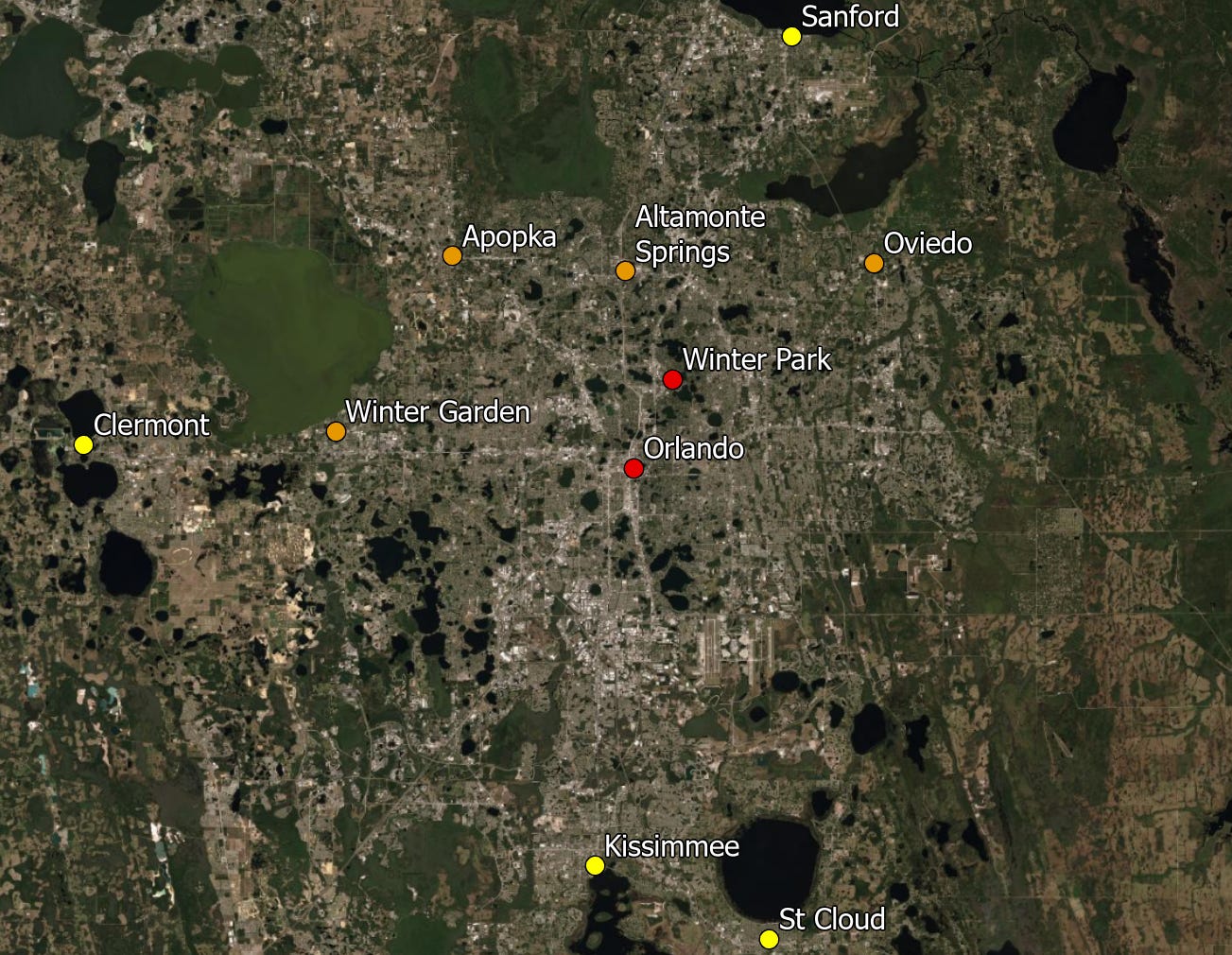
I analyzed the latest American Community Survey data (2020–2024) for ten cities across the Orlando metropolitan area. I looked at median home value, price-to-income ratio (PIR), and average commute time.
To understand these trade-offs clearly, we need to look beyond raw home prices.
Urban Core Housing & Commutes: Orlando & Winter Park
While the cost of housing matters a great deal, the price-to-income ratio provides a rough but meaningful way to gauge how a given city is doing. As Demographia puts it: “Often housing affordability is evaluated simply by comparing house prices. However, without consideration of incomes, housing affordability cannot be assessed. Housing affordability is house prices in relation to incomes.”
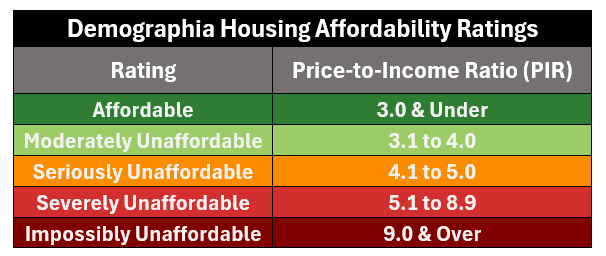
Demographia, the gold standard for international housing affordability research, puts it bluntly: “Middle-income homeownership was once widespread, with house prices aligned with incomes. Since the 1990s, however, prices have surged—especially in markets governed by urban containment strategies.” Their five-category rating system—from affordable to severely unaffordable—helps put these numbers into perspective.
I organized ten cities using the transect, a planning concept promoted by the Congress for the New Urbanism that views metropolitan areas from core to edge. The core offers the largest circle of opportunities. Jobs, restaurants, healthcare, entertainment, and services are all within reach. That access is one reason why the core commands such a premium.
Winter Park illustrates this particularly well. Unlike much of Florida’s suburban landscape, people actually walk there. Its historic downtown, on-street parking, diverse architecture, and SunRail station create a place that feels built for people rather than cars. As someone who grew up in France, Winter Park immediately felt familiar. People stroll along Park Avenue and linger outside cafés. It feels like a real place rather than another strip mall.
Orlando is the economic engine of Central Florida. While much of the city is sprawling and automobile-oriented, its urban core provides access to one of the region’s largest concentrations of jobs, entertainment, and services.

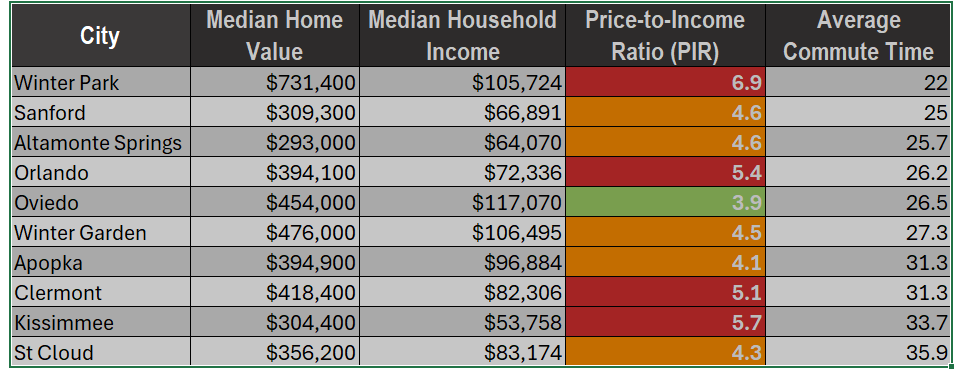
The biggest surprise was not the price — it was the commute. Despite some of the highest home values in the region, Winter Park posted the shortest average commute in this analysis at 22 minutes, well inside Alain Bertaud’s finding that the median commute across cities has remained stable at roughly 30 minutes each way.
Winter Park’s 6.9 and Orlando’s 5.4 both fall into severely unaffordable territory. It is also supply and demand. Winter Park’s residents have resisted new density for decades. As Edward Glaeser wrote, “when cities restrict new construction, they become more expensive” — and Winter Park proves it.
What do you gain in the core? Time and access. What do you pay? A premium few households can comfortably afford.
The Urban Center: Oviedo, Winter Garden, Apopka & Altamonte Springs
If the core maximizes access, the center may offer the best balance.
These communities form the first ring around the urban core. They retain access to many of the jobs, services, and amenities that make Orlando attractive while often offering a more manageable housing cost. For many households, the center may represent the practical middle ground between opportunity and affordability.

Oviedo stands out. A PIR of 3.9 is the strongest income-to-price ratio on this entire list. Combined with a 26.5-minute commute, it looks like the financial sweet spot of the metro — not paying the core premium, but not bleeding hours in traffic either.
Winter Garden tells a different story. Once a quiet community west of Orlando, it successfully reinvented itself around its historic downtown and trail network. Today it has become one of the most sought-after places in Central Florida. While its housing costs reflect that popularity, Winter Garden demonstrates that opportunity does not always have to flow toward Orlando. Communities can create their own destinations, culture, and identity.
Apopka at 4.1 PIR sits just inside seriously unaffordable, but the trade-off is a 31.3-minute commute. If you can absorb those extra five minutes each way, Apopka offers real breathing room in your budget. Altamonte Springs has the lowest median home value of the four, and its 25.7-minute commute keeps the door open to career opportunities in multiple directions.
The center asks a fair question: Do you need the core’s prestige, or just a short drive and a manageable payment?
Commuter Edge Housing: Clermont, St. Cloud, Kissimmee & Sanford
The edge is where the promise of “drive until you qualify” lives. But do you really get more house for less money? Sometimes. But almost always more miles — and those miles have direction.

The bigger difference is not price. It is direction.
On the edge, your job search radius is not a circle — it is a line pointing toward the core. St. Cloud residents drive north. Clermont residents drive east.

Yet Clermont's chain of lakes helps explain why many residents willingly make that trade. Boating, fishing, and life on the water are part of the area's identity, offering a lifestyle that is difficult to find closer to the center of the metro. The same geography that creates these amenities also places many regional job opportunities farther away.
Sanford is the exception. Its historic downtown on Lake Monroe, local employment base, and connections north of Orlando mean it functions differently from the southern edge communities.
Kissimmee is the hardest combination on this list: a 5.7 PIR with a 33.7-minute drive and the lowest median income in the study. The promise of “drive until you qualify” is most strained here.
What do you gain on the edge? Space, nature, and a quieter pace. What do you give up? The ability to change jobs without changing your life.
A 30-minute commute is normal. A 40-minute commute is where life starts to fray.
Conclusion: Finding the Right Balance of Housing Cost & Commute in Central Florida
For me, Oviedo emerges as the best overall balance among the ten cities I analyzed. It has the lowest Price-to-Income Ratio (PIR) at 3.9 while maintaining an average commute of 26.5 minutes. Sanford and Altamonte Springs also stand out, combining relatively moderate housing costs with some of the shortest commutes in the study.
But I don’t think there is a perfect place to live. At different stages of life, our needs and wants change. Some of us may value a shorter commute and access to more opportunities. Others may gladly trade that for more space, nature, a quieter pace, or simply a place that feels like home.
Jane Jacobs wrote: “Lively, diverse, intense cities contain the seeds of their own regeneration.” To me, that is part of what makes cities interesting: different places work for different people at different stages of life.
The data reinforced something I have long believed as a geographer: opportunity has a geography. Where we live shapes our circle of opportunity—the jobs, amenities, people, and places within reasonable reach. As we move farther out, that circle doesn’t necessarily disappear, but it changes.
When buying a home, perhaps the better question isn’t simply “Can I afford it?” but “What opportunities am I buying—and what opportunities am I leaving behind?”
Next time you scroll a listing, look past the price tag. Look at the price-to-income ratio. Look at the commute.
Ask yourself: Will I have the time to know my neighbors—and will they have the time to know me?
Disclaimer: The views expressed in this article are solely my own and do not reflect those of any public agency, employer, or affiliated organization. This blog aims to educate and empower readers through objective geographic and planning insights, fostering informed discussion on global and regional issues.