
On February 28, 2026, Ayatollah Ali Khamenei, Iran’s supreme leader for nearly four decades, was killed in a joint US-Israeli airstrike. The attack — called “Epic Fury” by the Pentagon — marked the beginning of a new war in the Middle East.
“War is politics by other means,” wrote Carl von Clausewitz. But strategy itself is shaped by deeper forces. Napoleon Bonaparte defined strategy as the art of using time and space. Sun Tzu went further: the greatest victory is won without fighting.
These three ideas — politics, time, and space — frame the conflict now unfolding.
The United States is one of the few countries that can start a war far from home as a maritime nation. But geography changes the math. This is not a war of quick victory — it is a test of who can endure longer under geographic and economic pressure. In this piece, I will explore the conflict through that lens.
Geography & Landscape
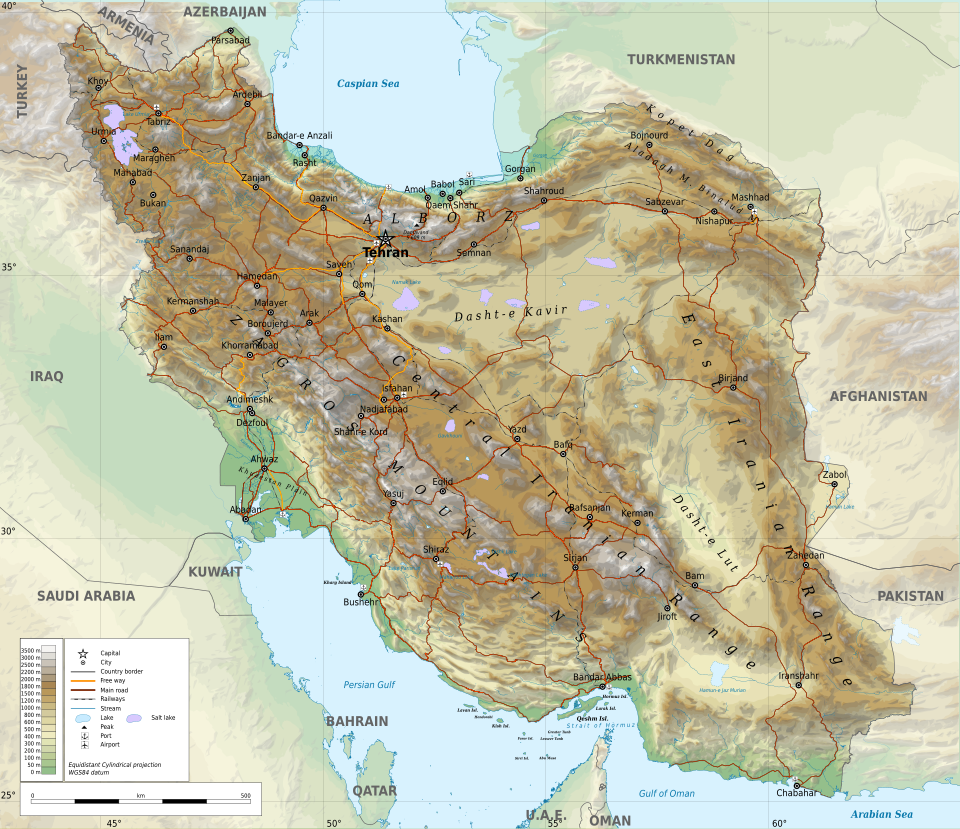
Iran is a fairly large country with 1,648,195 square kilometers which is about 2.5 times the size of Texas. In European terms, it is larger than France, Italy, and Germany combined. At the heart of the country lies the Iranian Plateau — a high, arid expanse averaging 900 to 1,500 meters above sea level. This is not coastal lowland or fertile plain. It is a raised platform that shapes everything: how water moves, how armies march, how empires endure.
When you look at the topographic map above, several geographic factors stand out.
Do not imagine endless sand dunes but rather-- picture valleys of high desert, rugged mountains, and scattered oases. Mountains catch the snow. Valleys hold the water. Without that water, you die. I think of the Great Basin in the American Southwest — the harsh landscape around Las Vegas, surrounded by mountains that the locals know like the back of their hand.
Iran has two major mountain ranges. The Zagros runs from the Strait of Hormuz all the way northwest to the Turkish border — a 1,600-kilometer wall that separates Iran from Iraq. The Alborz runs east to west across the north, guarding the capital, Tehran. Of the two, the Zagros is the most significant in any conflict with the US. It hugs the Strait. It blocks the most likely invasion routes. It is the first obstacle — and may be the last.
Mountainous terrain tends to favor defense and reward societies that develop resilience, local knowledge, and self-reliance over time. From the Swiss Alps to the Caucasus and Iran's Zagros, geography has consistently rewarded endurance and asymmetric tactics — patterns long observed by geopolitical thinkers. These are not passive landscapes; they shape how people fight, adapt, and endure.
But Iran is not just terrain. It is one of the world’s great civilizations — heir to Persepolis, homeland of Cyrus the Great and Darius the Great. That matters because a civilization does not break like a regime. It endures. It waits. It has seen empires come and go. The Iranians are not irrational. They simply operate from a different history, a different set of memories. Unlike many modern countries in the Middle East — Iraq, Jordan, Syria — whose borders were carved by Western powers after World War I, Iran is not artificial. It is not a colonial drawing. Iran was a superpower of the ancient world, and it has never forgotten that. That memory is a weapon.
Geography does not decide the war—but it impacts the cost of fighting it.
The Mountain Fortress
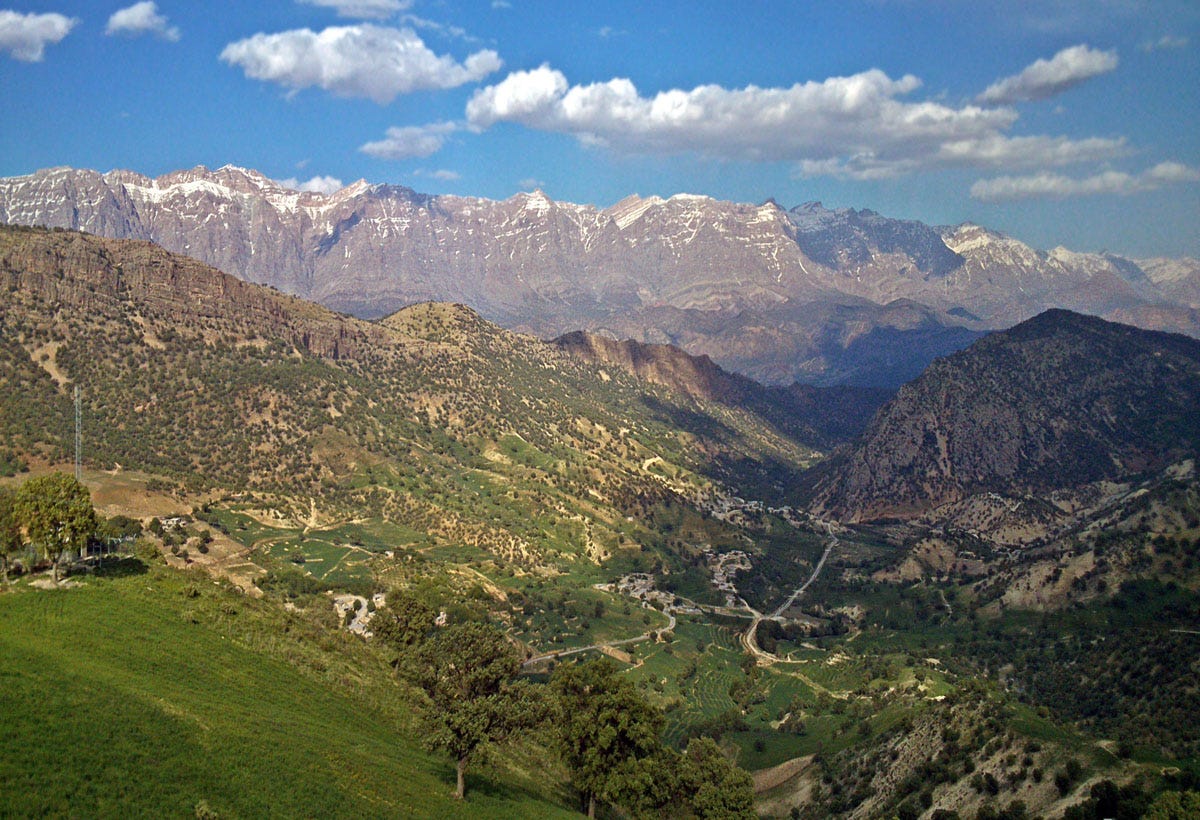
Iran is the fortress nation in my eyes. The US is a maritime superpower that can project force nearly anywhere — but power projection is not the same as victory. The US operates far from home with stretched logistics. Iran holds the heights.
History offers a warning. In 330 BC, Alexander the Great — one of the finest military minds before Napoleon — was ambushed in the Zagros at the Persian Gates. His army took heavy casualties. The pass held him for a month. He only succeeded because a local shepherd showed him a secret path around the Persian defenses.
More recently, Saddam Hussein learned the same lesson. In the Iran-Iraq War of the 1980s, Iraqi forces paid a heavy price in troops and time just to break through the outer defenses of the Zagros. They never reached Tehran.
Sun Tzu understood mountain warfare: “To cross mountains, follow the valley, search out tenable grounds, and occupy the heights. If the enemy holds the heights, do not climb to engage.” And again: “Being unconquerable lies with yourself; being conquerable lies with the enemy.”
Iran fortifies. It waits for the enemy’s political season to shift. Think of the United States as an eagle — dominant in the air, capable of striking with speed and precision, but operating far from home. Iran is like a mountain viper — embedded in its terrain. It does not need to match the eagle’s reach; it only needs to endure and exploit the limits of distance.
Any invasion of Iran is not just a military operation—it is a logistical risk.
The Strait of Hormuz
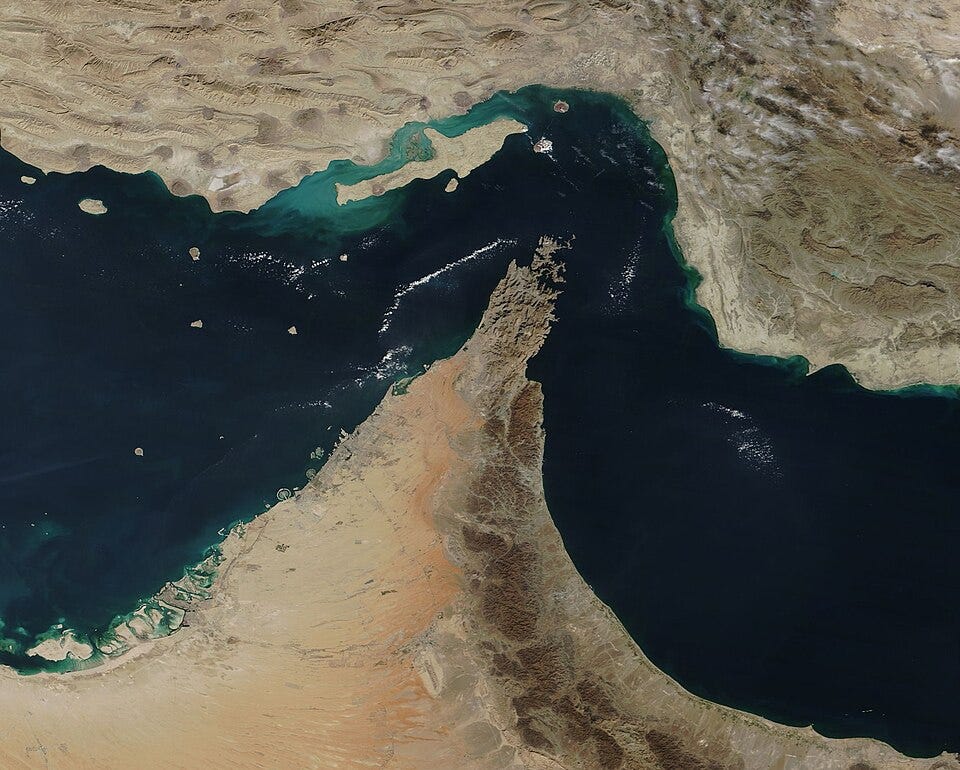
The Strait of Hormuz, located between Oman and Iran, connects the Persian Gulf with the Gulf of Oman and the Arabian Sea. The Strait is deep enough and wide enough to handle the world’s largest crude oil tankers, and its narrowest width measures just 39 kilometers. In other words, the Strait is a chokepoint — because its location is critical, it can choke logistics and trade.
Strategically, the Iranians surround the narrow points on three sides.
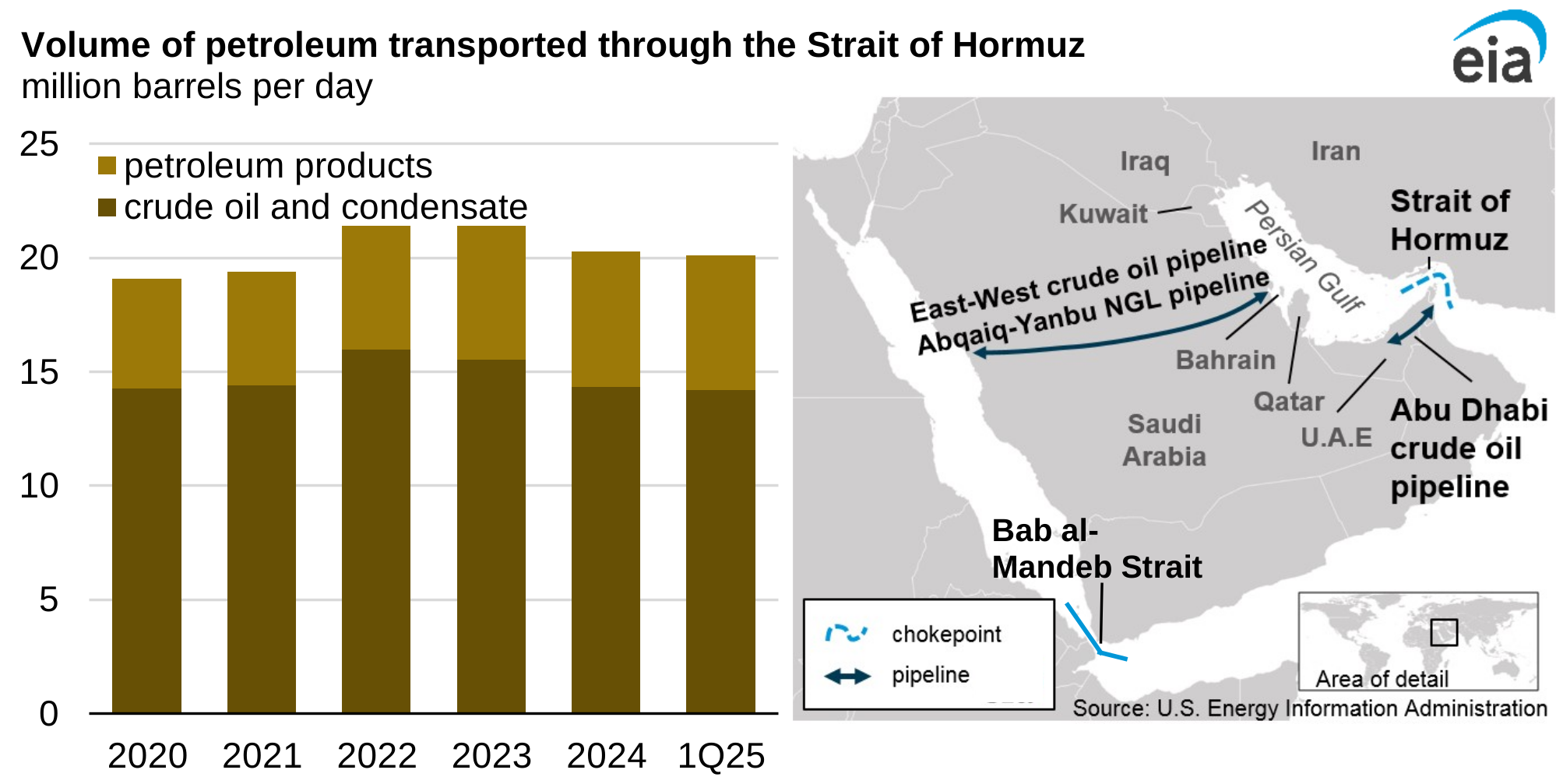
Economically, the numbers are stark. In 2024, 20 million barrels of oil per day passed through the Strait — about 20 percent of global petroleum consumption. In the first quarter of 2025, close to 27 percent of all maritime oil trade transited through the Strait. Eighty-four percent of that oil goes to Asia: China, India, Japan, and South Korea.
But the real weapon is not the oil itself. It is the human calculation.
Sailors are people. They have families. They have limits. If a tanker is mined or struck by a drone, the next crew may refuse to sail. Shipping companies will reroute. Insurance premiums will spike. The journey becomes too expensive, too slow, too deadly — not because every ship is sunk, but because enough crews are afraid.
Iran does not need to stop all shipping. It only needs to make the risk real. It has the tools to do that: mining the Strait, deploying cheap kamikaze drones, harassing commercial vessels.
The war with Iran is, at its core, economic warfare. “No country has ever profited from protracted warfare.”
The Strait of Hormuz is the crossbow, already drawn — ready to release.
The Endgame: Cost, Attrition, Alliances
As I reflect on recent US-led wars: Afghanistan was a guerrilla war, Iraq a conventional war. Iran is siege warfare behind a mountain wall — and the pain spreads to every gas station on Earth. Iran will always hold the heights. The Strait of Hormuz will always be narrow. The US can win every battle and still lose the war of attrition. Only time will tell who emerges victorious — if anyone does.
So here are the key things to watch in this war:
How much economic pain will American voters tolerate before they demand an end?
How much suffering can the Iranian regime absorb before the streets of Tehran answer back? And how much economic pain will US allies like Germany, South Korea, and Japan endure before they demand action?
No one knows. But the answers will matter more than any single battle. This war will not be decided by who strikes harder—but by who endures longer under the constraints of geography, time, and economic pressure.
Disclaimer: The views expressed here are solely my own and do not reflect those of any public agency, employer, or affiliated organization. It empowers readers with objective geographic and planning insights to encourage informed discussion on global and regional issues.