
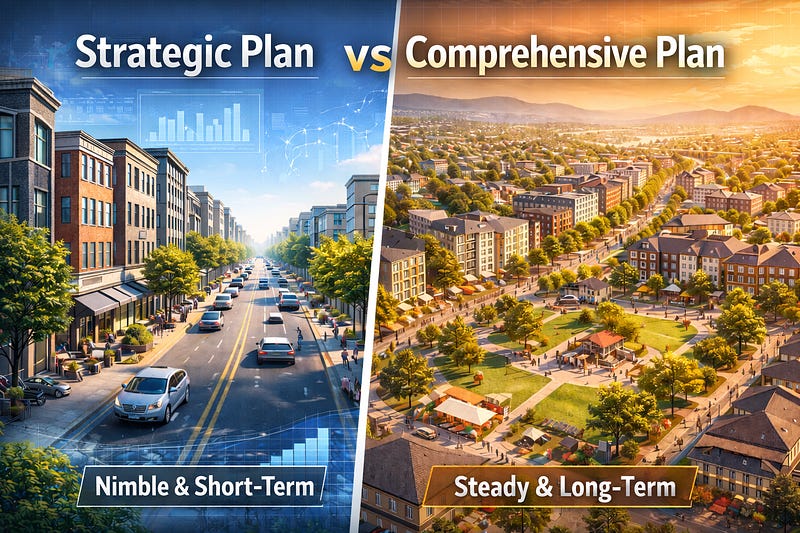
Local governments—such as cities and counties—routinely use both a comprehensive plan and a strategic plan to guide long-term growth and short-term action.
People often treat them as the same thing. They are not.
I have noticed many people struggle to clearly explain the difference. I hope this article — and this analogy — helps bring clarity.
Motorcycle vs. Semi-Truck
Think of a strategic plan like a motorcycle.
The motorcycle is nimble. It moves quickly and can change direction when the road changes. It is built for the short- to mid-term journey, allowing you to scout ahead and react to what is right in front of you.
Think of a comprehensive plan like a semi-truck.
In some states it is called a General Plan or a Master Plan. The name changes. The purpose does not.
The semi-truck is steady. It carries the heavy weight — the long-term vision and core direction. It requires more space and time to turn because it is hauling the cargo that sustains the entire journey. It defines the main route and provides the stability everything else depends on.
The motorcycle scouts ahead. The semi-truck carries the long haul.
The Strategic Plan (The Motorcycle)
The American Planning Association (APA) defines strategic planning in PAS Report 607 as:
“Strategic planning is any short-term process designed to take advantage of strategic opportunities that results in a plan for concrete actions or programs.”
That definition matters.
A strategic plan is primarily an internal and operational guide. It focuses on how an organization will move forward right now. It sets short- to mid-term priorities — often three to five years. It identifies specific actions, assigns responsibility, and defines how to measure progress.
It asks: What are our top priorities for the next few years, and how will we achieve them?
Its nature is flexible. A strategic plan is meant to adjust as conditions change. If the road is blocked, the motorcycle finds a new path. It is action-oriented and typically not legally binding.
The Comprehensive Plan (The Semi-Truck)
The American Planning Association defines the comprehensive plan in Planning and Urban Design Standards, 1st Edition (often called the “Blue Book”) as:
“The comprehensive plan is the adopted official statement of a local government’s legislative body for future development and conservation. It sets forth goals; analyzes existing conditions and trends; describes and illustrates a vision for the physical, social, and economic characteristics of the community in the years ahead; and outlines policies and guidelines intended to implement that vision.”
That definition is formal — and that is intentional.
In plain language, the comprehensive plan is the community’s long-term blueprint. It is adopted by the governing body. It looks ten to twenty years ahead. It analyzes data, sets goals, and establishes policies that guide growth, infrastructure, housing, transportation, conservation, and economic development.
It asks: Where are we going, and what principles will guide us there?
Its nature is foundational. It carries legal and policy weight. Major decisions — zoning, capital improvements, development approvals — must align with it. It is not meant to pivot every year. It provides steady direction.
If the strategic plan organizes how we move, the comprehensive plan defines where we are headed.
Conclusion
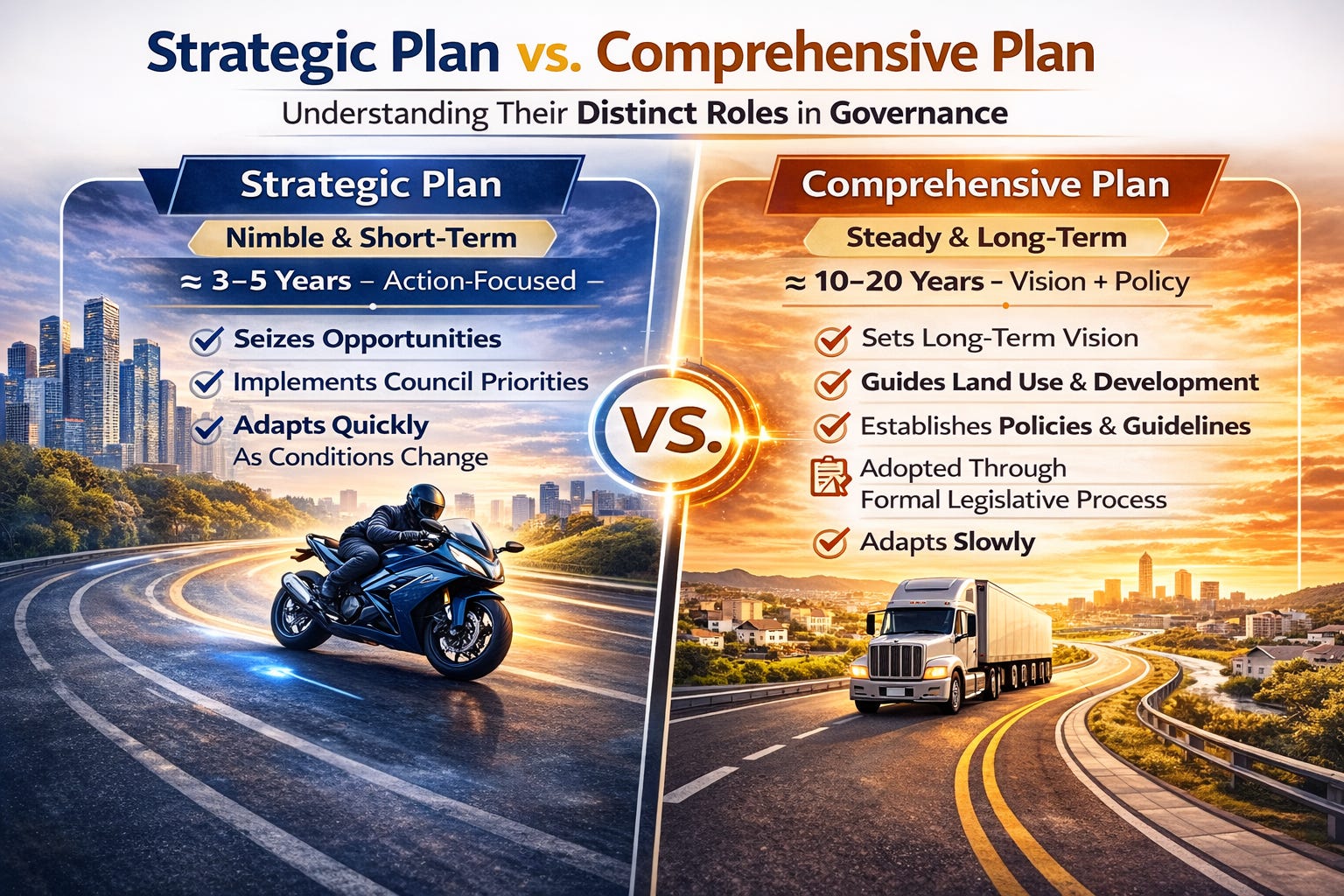
If you remember nothing else, remember this:
The motorcycle (Strategic Plan) is nimble. It guides short-term action and adjusts as conditions change.
The semi-truck (Comprehensive Plan, also called a General Plan or Master Plan) is steady. It carries the long-term vision and provides the legal and policy framework everything else must follow.
Strong organizations need both. They need the ability to react — and the discipline to stay the course. One scouts the path ahead. The other ensures you actually reach the destination.
Disclaimer: The views expressed here are solely my own and do not reflect those of any public agency, employer, or affiliated organization. It empowers readers with objective geographic and planning insights to encourage informed discussion on global and regional issues.