
We all know the real estate cliché: location, location, location. But for most of us, that phrase gets reduced to one thing: the price tag on the house.
That’s a mistake.
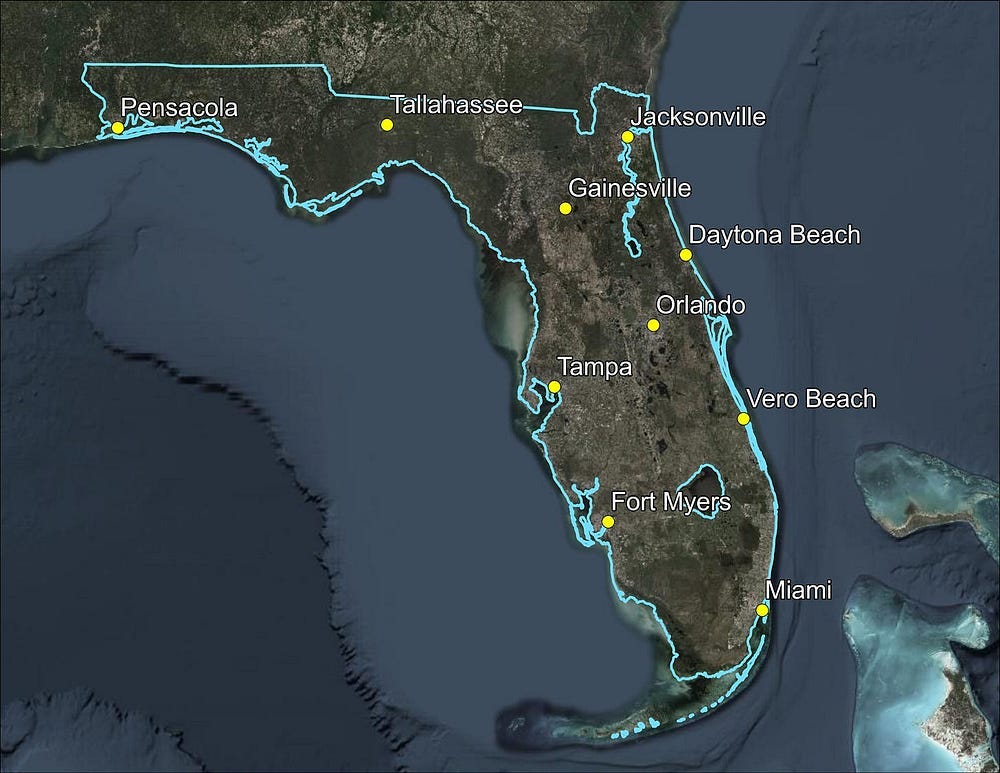
I analyzed the latest American Community Survey data (2020-2024) for ten Florida cities. I looked at three things: median home value, price-to-income ratio (PIR), and average commute time.
Why? Because a long commute isn’t just a financial cost—it’s time you will never get back. And a high price-to-income ratio doesn’t just stress your budget; it stresses the people around you. By the end, you’ll have a new way to see any city, not just in Florida.
How I Compared Cities
I chose the American Community Survey (ACS) over private real-estate sources because it provides standardized, publicly vetted estimates for all three variables in one consistent dataset. This allows for “apples-to-apples” comparisons that market snapshots simply cannot match.
To find the best overall trade-off, I normalized these metrics onto the same scale and averaged them into a single Affordability Index. Here is what each metric shows on its own.
Housing Cost
Here is what everyone looks at first. The sticker price.
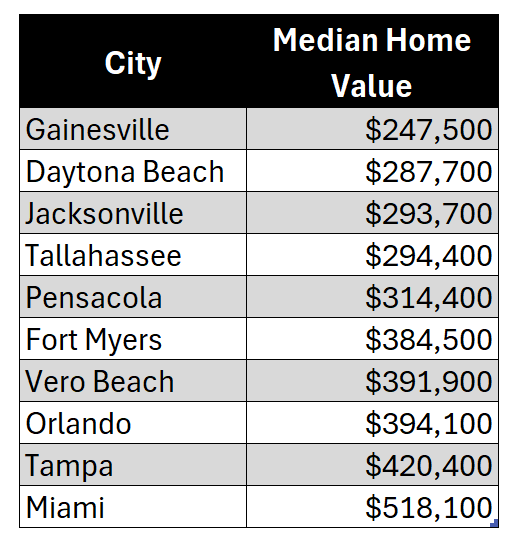
On the surface, Gainesville has the best median home value while Miami has the most expensive one. But affordability here doesn't imply a lack of character or amenities. Gainesville is home to unique ecosystems like the Devil’s Millhopper Geological State Park—a miniature rainforest inside a 120-foot deep sinkhole that stays cool even in the peak of a Florida summer.

Pensacola and Daytona Beach also have the most comfortable climate in Florida (I analyzed that separately using NOAA data). However, the price of a home alone can be misleading. As an urban planner, I see this as a high-level gauge; a true “deep dive” into monthly carry costs must also account for property taxes, HOA fees, insurance, and Community Development District (CDD) fees, which vary significantly across Florida.
While we all consider factors such as housing cost, school, crime, amenities, natural charms, it is housing that we usually put first. However, housing cost is generally one of the main factors when purchasing home. Another real estate cliché is drive until you qualify which means that our dream home may actually be farther.
But price alone tells an incomplete story. A cheap house in a town with low wages is not a bargain. Which brings us to the price-to-income ratio.
Price to Income
While the cost of housing matters a great deal, the price-to-income ratio provides a rough but meaningful way to gauge how a given city is doing. As Demographia puts it: “Often housing affordability is evaluated simply by comparing house prices. However, without consideration of incomes, housing affordability cannot be assessed. Housing affordability is house prices in relation to incomes.” Demographia, the gold standard for international housing affordability research, puts it bluntly: “Middle-income homeownership was once widespread, with house prices aligned with incomes. Since the 1990s, however, prices have surged—especially in markets governed by urban containment strategies. Here is their five-category rating system. It will help you put Florida’s numbers into perspective.
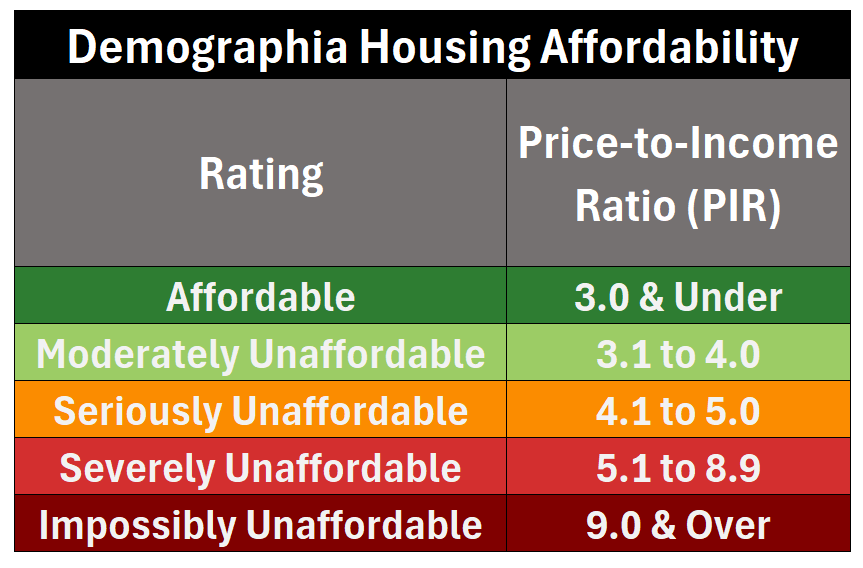
Jacksonville and Pensacola are both seriously unaffordable at 4.2 while the rest of the Cities falling into severely unaffordable with Miami at 8.3, clearly with the worst ratio of them all. When we look beyond the numbers, here is what I see as an urban planner: communities stretched thin. Edward Glaeser wrote that “when cities restrict new construction, they become more expensive.” He warned that Paris—once home to starving artists—is now affordable only to the wealthy. Florida isn’t Paris. But the math is moving in the same direction. When every dollar goes to the mortgage, we lose the ability to enjoy our families, our communities, our lives. In other words, let’s see this price to income ratio as a stress test of a community. The more stress we have the more we must make sacrifices. Now, if the local job market does not pay what we need to support ourselves and family then this is when we have to look for other jobs and perhaps drive farther until we can find this job. However, it will once again come at a price. I expected Miami to be the most expensive. What surprised me was the low Median Household Income — making the situation significantly worse than I expected
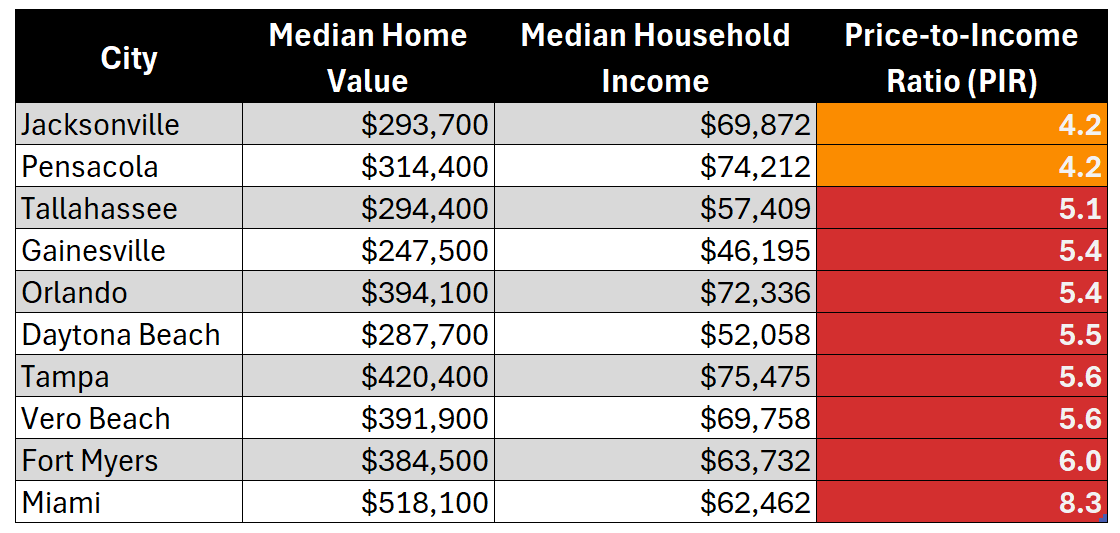
Applying Demographia categories — from affordable to severely unaffordable — gives a fast read on any area within a metro. Main references: Demographia Housing Affordability Index, US Census QuickFacts, Bertaud’s Order Without Design. Supporting quotes from Edward Glaeser (Triumph of the City), Jane Jacobs, and Thomas Sowell on trade-offs.
Now that we understand the financial stress each city places on its residents, let’s look at the other hidden cost: time.
Average Commute Time
Now let’s look at the average commute time which deserves more attention than it receives.
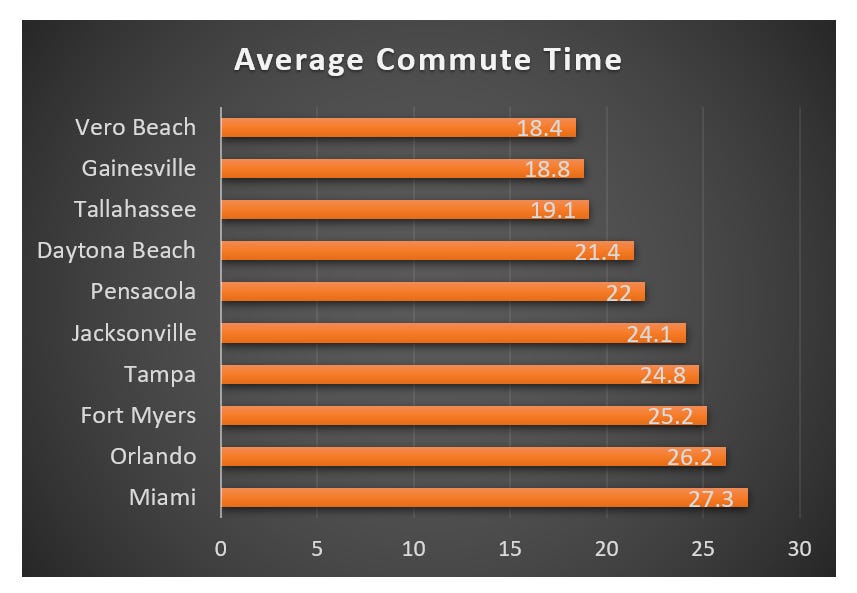
Vero Beach wins with an average commute time of 18.4 whereas Miami loses again with 27.3. But here is the insight: A 30-minute commute is normal. A 40-minute commute is where life starts to fray. The smaller metros in Florida offer you something money cannot buy: time.
I want to take a moment here and step back and share some key insights. Cesare Marchetti found that across cultures and centuries, humans consistently spend about one hour per day traveling. Not more. Not less.
Alain Bertaud, former principal urban planner at the World Bank, confirms this with modern data: “Urban commuting surveys indicate that the median travel time across cities and countries is, and for long time has been, remarkably stable, with approximate mean of 30 minutes each way.”
The time doesn’t change. What changes is distance. A person walking 30 minutes from home covers about 2.5 kilometers. A person driving 30 minutes covers 10 times that. All in all, the smaller cities have faster average commute time which is to be expected.
What Marchetti’s constant reveals is the cliché of “drive until you qualify” deserves to be considered more fully. We all know that there is a cost to driving further which can considerably impact housing affordability and especially when gas prices go up. However, the real insights are that the longer commute times has a hidden social cost on us, family, and community.
Conclusion
When you combine Housing Cost, Price to Income Ratio, and Average Commute time, the picture changes. Gainesville emerges as the most affordable. Miami is expensive with a longer drive than the other cities but within a range that is sustainable and in line with Marchetti’s constant discussed earlier. The sweet spot is where income meets home price and the drive is short.
Final Ranking: Best Overall Affordability & Commute
1. Gainesville
2. Jacksonville
3. Tallahassee
4. Pensacola
5. Daytona Beach
6. Vero Beach
7. Orlando
8. Tampa
9. Fort Myers
10. Miami
What’s your number? Calculate your own price-to-income ratio: divide your local median home value by median household income. Then ask: Is the commute worth it?
What Should You Do With This?
Lowest Home Value Cost: Gainesville
Best Price to Income Ratio: Jacksonville
Shortest commute: Vero Beach

Jane Jacobs understood what a healthy city needs. She wrote: “Lively, diverse, intense cities contain the seeds of their own regeneration.”
Next time you are scrolling through a Zillow listing, look past the price tag. Look at the commute and the Price-to-Income Ratio. The more time we spend in our cars, the less we know the people where we live.
Ask yourself: Will I have the time to know my neighbors—and will they have the time to know me?
Disclaimer: The views expressed in this article are solely my own and do not reflect those of any public agency, employer, or affiliated organization. This blog aims to educate and empower readers through objective geographic and planning insights, fostering informed discussion on global and regional issues.