
Book Brief
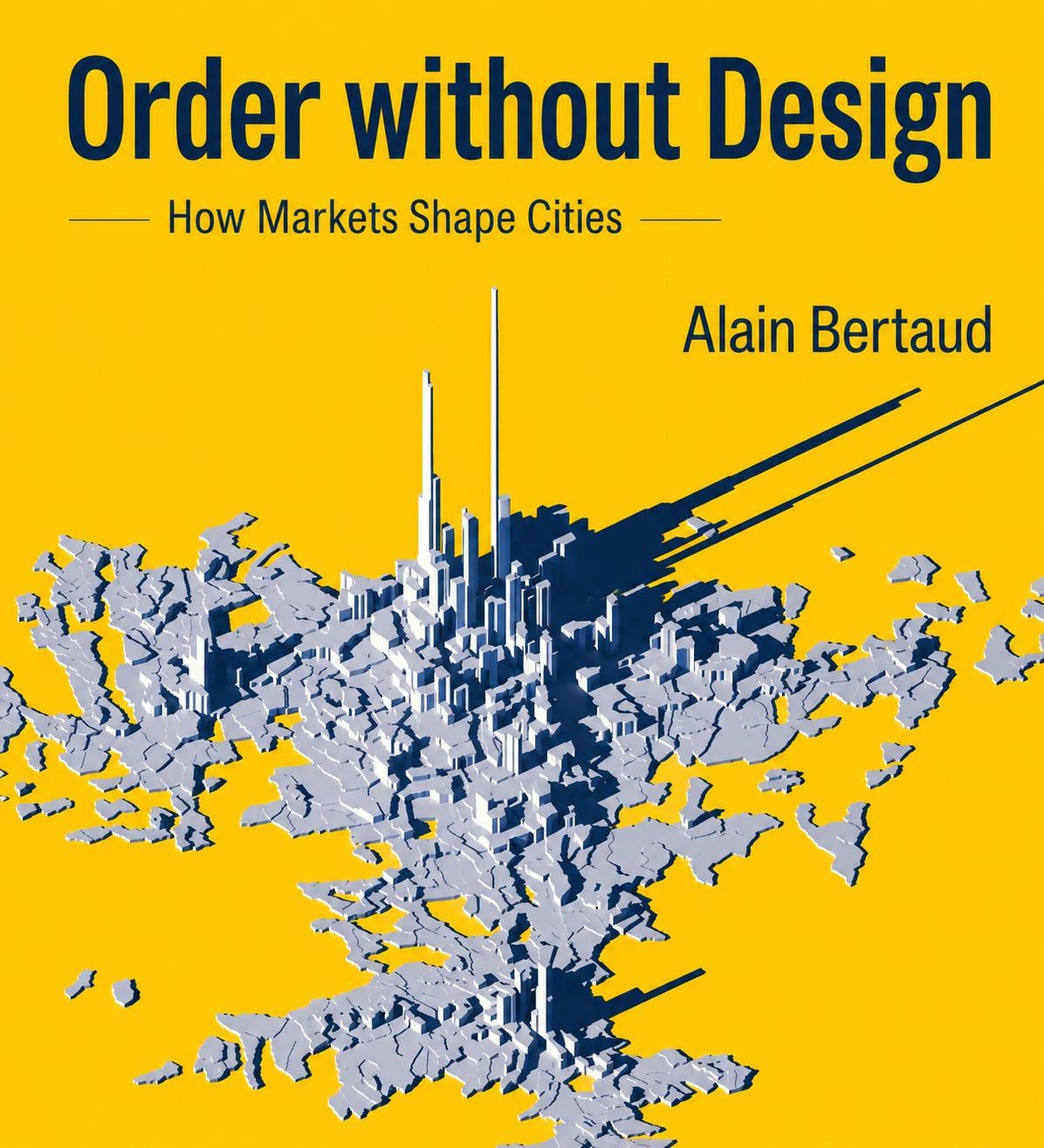
Order Without Design by Alain Bertaud, former Principal Urban Planner at the World Bank, is one of the most influential books I've read on the relationship between urban planning and economics. Bertaud argues that cities are not shaped primarily by comprehensive plans or master plans—they are shaped by markets. Good planning requires understanding how land prices, transportation, commuting patterns, and housing markets interact. His central message is simple but profound: planners and urban economists should work together because great cities emerge from the interaction of sound public policy and market forces.
Why Read This Book?
If you’ve ever wondered why housing becomes unaffordable, why traffic congestion persists, or why well-intentioned planning policies sometimes produce unintended consequences, this book provides an economic framework for understanding cities. While written for planners, its lessons are equally valuable for elected officials, developers, transportation professionals, and anyone interested in how cities grow and change.
Several ideas in this book inspired articles I’ve written:
Drive Until You Qualify – How housing affordability and commuting are more closely connected than many people realize.
The Affordability Trap – Why housing prices alone don’t tell the full story of affordability.
Key Insights
1. Planning Must Consider Economics
Perhaps Bertaud’s most important message is that good planning cannot be separated from economics. Master plans should account for real estate markets, land values, transportation costs, commuting times, and supply and demand—not just future land use maps.
2. Mobility Creates Opportunity
Transportation is not simply about moving vehicles; it connects people to jobs and opportunity. Bertaud emphasizes the importance of travel time and the number of jobs workers can access within a reasonable commute.
While reading this section, I immediately made a connection to Marchetti Constant, the observation that people across different places and periods have tended to maintain a relatively stable daily travel-time budget of roughly one hour. That connection reinforced something important for me: where you live matters just as much as what you pay for your home because accessibility shapes opportunity.
3. Markets Shape Urban Form
Governments establish regulations and build infrastructure, but markets ultimately determine where density occurs and how land is used. Roads, bridges, and transit investments create value only when they improve access to places where people want to live, work, and do business.
4. Housing Affordability Depends on Supply
Bertaud argues that every binding regulation carries a cost. Restrictions on density, excessive development requirements, and policies that limit housing supply can unintentionally increase housing prices. Good planning requires balancing community goals with the realities of the housing market.
5. Measure What Matters
Planning departments should monitor indicators that reflect how cities actually function, including housing affordability, land values, commute times, and accessibility. Regulations should be evaluated through cost-benefit analysis rather than assuming they automatically improve communities. Bertaud recommends that planners monitor key indicators such as the price-to-income ratio and trends in average commute times.
Favorite Quotes
“Road congestion is a real estate problem.”
“In the real world, it is only markets that determine land and floor consumption and, therefore, population densities.”
“Markets shape cities through land prices”
“In absence of mobility, there is no increase in productivity despite high density”
“All regulations should be submitted to a cost-benefit analysis.”
"When inclusionary zoning is voluntary, the government must provide developers with incentives, either a regulatory change allowing more apartments to be built on the same parcel, or a tax abatement (or both)."
My Takeaways
This book challenged me to think more deeply about the relationship between planning and economics. One connection that surprised me most while reading Bertaud was the relationship between his discussion of commuting and the concept of Marchetti's Constant. If people naturally devote about an hour each day to travel, then accessibility—not simply housing price—should be a central consideration in planning. Will I have the time to know my neighbors—and will they have the time to know me?
It also reinforced the importance of testing planning ideas against market realities. Well-intentioned regulations can create unintended consequences when they ignore economics. At the same time, I don’t believe economics alone explains cities. Cities are also political, cultural, and ecological systems. Good planning requires balancing market forces with environmental stewardship, historic preservation, and the public realm.
Finally, I found myself drawing strong connections to Strong Towns. Bertaud focuses on markets and land values, while Strong Towns emphasizes fiscal resilience and value per acre. Together, they offer a more complete way of thinking about how cities grow, invest, and remain financially sustainable.
I highly recommend Order Without Design to anyone who wants to become a better planner—or simply better understand how cities actually work.
Disclaimer: The views expressed in this article are solely my own and do not reflect those of any public agency, employer, or affiliated organization. This blog aims to educate and empower readers through objective geographic and planning insights, fostering informed discussion on global and regional issues.